Java is a case sensitive programming language.
Programming language is nothing but a set of instruction given to a computer.
JAVA was developed by JAMES GOSLING

who is known as the father of JAVA, in 1995.
SYMBOL OF JAVA: Cup and saucer with steam coming out.

JAVA’S slogan: Write Once Run Anywhere (WORA).
COUNTRY OF ORIGIN: US
Currently, JAVA is used in internet programming, mobile devices, games, e-business solutions, etc.
FEATURES OF JAVA:
- JAVA is simple- Pre defined codes can be reused.
- JAVA is robust-It is nothing but powerful, which accepts both simple and complex calculations.
- Multithreaded – Parallel programming, at a time we can process multiple program.
- JAVA is popular – Most preferred and widely used in IT industry.
- Platform independent– java compiled code(byte code) can run on all operating systems.
- High performance – When JAVA is introduced, JAVA is 25 times faster than python.
JDK (JAVA DEVELOPMENT KIT)
JDK is nothing but a software development kit to develop applications in Java. JDK is platform dependent ( i.e there is separate installers for Windows, Mac, and Unix systems.)
Initial version: JDK 1.1 or JDK 1
Current version: JDK 1.19 or JDK 19.
NOTE: There are different version/flavours of JDK available in the market, we need to download a suitable version specific to our machine.
JVM ( JAVA VIRTUAL MACHINE)
JVM is platform dependent which makes JAVA platform independent. JVM which is responsible for converting Byte code to the machine specific code.JVM does not include software development tools. Only Runtime environment for executing the Java byte code.
JRE (JAVA RUNTIME ENVIRONMENT)
JRE is defined as a software package that provides Java class libraries, along with Java Virtual Machine (JVM), and other components to run applications written in Java programming. Like JDK, JRE is also platform dependent.

COMPILE TIME AND RUNTIME:

In java running a program happens in two steps, compilation and then execution.
COMPILE TIME: (Ensure no syntax mistake)
If a program element(class, method, variable, statements etc) is not written as per it’s syntax in java, the compiler throws error for that element while compiling the program. We call these errors as compile time errors as these errors are detected at compile time by the java compiler.
At compile time, the java compiler(javac) takes the source code(.java file) and checks if there is any syntax, type-checking inside the program. If there is no error, the compiler generates a .class(bytecode) file for that .java file.
RUNTIME: (Ensure no logical mistake)
As soon as the programmer starts executing the program using java command, runtime gets started and it ends when execution of program ended either successfully or unsuccessfully. In other way the process of running a program is known as runtime.
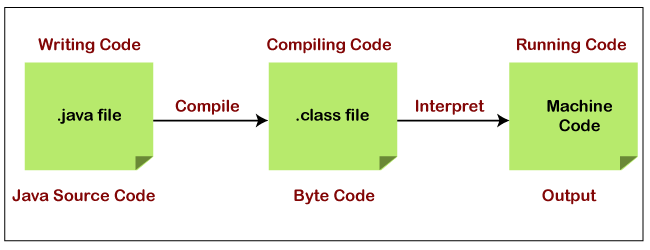
Difference between runtime and compile time:
Compile time is a process in which java compiler compiles the java program and generates a .class file. In other way, in compile time java source code(.java file) is converted in to .class file using java compiler.
where as, in runtime the java virtual machine loads the .class file in memory and executes that class to generate the output of program.
- Without compilation you can not run the program, compile first then run.
- The output of a program is generated in runtime, not in compile time.
- If you made any changes in program after compilation, you need to compile the program again to see the changes in output.
 Site Title
Leave a comment